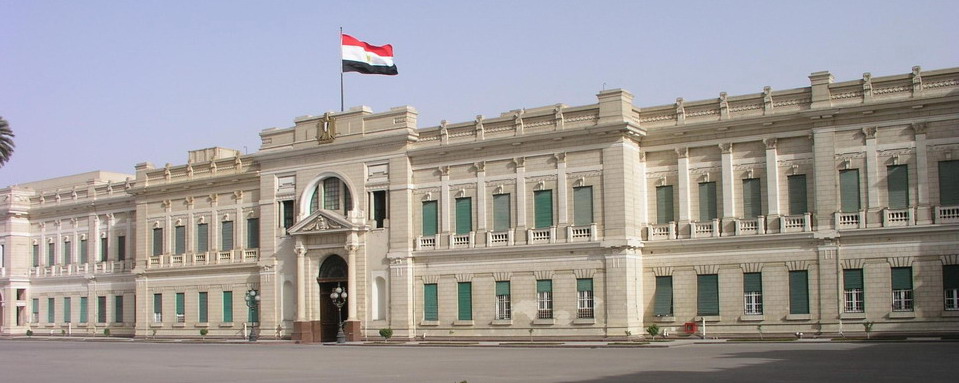
Abdeen Palace is the most imposing building most visitors to Cairo never enter. Its great north façade faces onto the square that carries its name, a vast dusty rectangle of palms and parked cars just south of the busy Bab al-Khalq district; its south and east wings close off a formal rear garden that is, on some days, the most civil outdoor space in central Cairo. The palace was built in 1872 by order of Khedive Ismail as a replacement for the older Citadel residence of the Egyptian royal family. For the next eighty years it was the functioning head of state's house. Today, a section of the palace is open to the public as a complex of five themed museums.
This is a slightly peculiar arrangement. The museums are small and densely hung, the palace itself is vast, and the relationship between the two — between the building you are walking through and the collections it holds — is not always obvious. Come with patience, and the visit rewards it.
The Arms Museum
The first and largest of the museums is dedicated to the Egyptian royal family's collection of arms. This is a chronological display of swords, daggers, pistols, rifles, suits of armour, and decorative weapons, organised broadly by period — Mamluk, Ottoman, nineteenth-century European, twentieth-century ceremonial. The Mamluk daggers are exceptional: curved blades, inlaid hilts, lapis-set pommels. One case holds a set of jewelled swords given to Khedive Ismail as diplomatic gifts in the 1870s; another holds the ceremonial weapons carried by King Farouk's guard.
The interest of the Arms Museum is less the weapons themselves than what they tell you about how a nineteenth-century Egyptian monarchy conceived of itself. A state that accepts a jewelled Russian sabre from a visiting tsar, or a gold-inlaid pair of Italian duelling pistols from a Piedmontese ambassador, is a state participating in a specific nineteenth-century diplomatic economy. Each object is a piece of that economy.
The Medals and Decorations Museum
A smaller room off the main arms gallery holds the royal family's collection of medals, sashes, and foreign decorations. This is the most concentrated display of nineteenth-century European vanity in Cairo: an Order of the Elephant from the King of Denmark, a Sash of the Golden Fleece from the King of Spain, a bewildering array of French, Russian, and Ottoman honours. The captions are minimal; the visual effect is of a cabinet of heraldic colour.
The Silver Museum
The Silver Museum holds the royal household's banqueting silver — trays, tureens, candelabra, coffee services, punchbowls, épergnes. Much of it was commissioned in London, Paris, and Vienna in the second half of the nineteenth century. Look for the Khedive Ismail coffee service, its pot chased with a pattern of Egyptian lotus and papyrus — a striking fusion of European silverwork traditions with pharaonic decorative vocabulary. The same hybrid visual language, applied to tureens, salt cellars, and a magnificent centrepiece depicting the Sphinx, recurs throughout the collection. This is where the nineteenth-century Egyptian elite's interest in its own pharaonic past first manifested in the objects of daily life.
The Presidential Gifts Museum
The newest of the five, this museum holds the gifts received by Egyptian presidents from foreign heads of state since 1952. It is also the strangest. In one case, a rhinoceros-horn ceremonial cup from the King of Eswatini sits beside a Cuban humidor in mahogany and an ivory-inlaid Saudi jambiya. In another, a crystal globe from President Mitterrand shares a plinth with a porcelain horse from the People's Republic of China. The captions give the donor, the date, and the occasion. The overall effect is of a diplomatic catalogue, in physical form, of seventy years of Egyptian foreign policy.
The Historical Documents Museum
The last of the five is the quietest, and the one most serious readers will prefer. It holds selected documents from the royal archive: land grants, firmans, treaties, personal letters. Among them are a letter from Napoleon Bonaparte to Murad Bey, two firmans issued by Sultan Abdul Hamid II confirming the hereditary status of the Egyptian khedivate, and a copy of the 1840 London Convention that settled the international status of Egypt under Ottoman suzerainty. These are historical documents of serious weight, and the museum displays them with an accompanying translation into Arabic and English.
The garden
The rear garden of Abdeen Palace is not always open to the general public, but on the days when it is, it is worth the visit for the garden alone. The layout is formal, with geometric beds and clipped hedges, and a central fountain that still works. The garden is ringed by the palace's south and east wings, and the sense of being in a hidden interior space — an island of quiet in the middle of central Cairo — is remarkable.
Practical
Abdeen Palace is open to the public five days a week, with the standard mid-day break. The entrance is on the east side of the palace, from Sharia al-Gomhouria. Tickets are inexpensive. The five museums can, in theory, be visited in three hours; I usually manage two if I am disciplined. Photography is permitted in some galleries and not in others. A visit can be combined conveniently with the Museum of Islamic Art at Bab al-Khalq, fifteen minutes' walk away.
A final observation
Abdeen is the single most direct window onto the material culture of the Egyptian royal family that remains accessible to the public. The palace is not arranged, however, as a house-museum; you do not walk through King Farouk's bedroom or see Queen Farida's dressing room. What you see instead are the objects the family owned — the weapons, the silver, the medals, the documents, the diplomatic gifts — presented in a more catalogue-like spirit. This is, on balance, the honest approach. It treats the royal family as a historical institution rather than as the subject of a biographical pilgrimage, and it leaves the visitor free to draw their own conclusions about what the monarchy was, and about what remains of it.