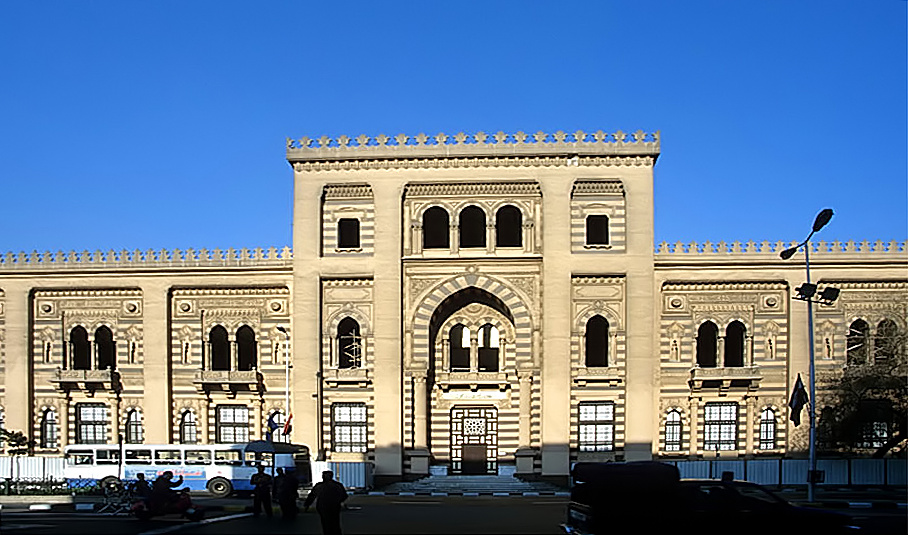
On a weekday morning in Bab al-Khalq, the Museum of Islamic Art is the quietest place in central Cairo. This is strange, because the building is about five minutes' walk from Tahrir Square, and the collection inside it is — by any credible count — the most important assembly of Islamic decorative arts in the world. The silence is not a failing of the museum. It is a condition the museum rewards.
I came on a Tuesday, paid the entrance fee at a small kiosk, and walked up the broad steps into the neo-Mamluk façade. The building, designed by Alfonso Manescalo and completed in 1903, sits at the awkward intersection of Port Said Street and Ahmed Maher Street, and its exterior — mashrabiya stone latticework, Arabic epigraphy along the cornice — prepares the visitor for the interior only in the most general way. Inside, the museum has been reinstalled twice since 1903. The current display, reopened in 2010 after a comprehensive redesign, was partially damaged in the January 2014 bombing that struck the adjacent Cairo Security Directorate. Restoration work after the bombing was extensive. The galleries you see today are the result.
The first room, and why it matters
The first room sets the tone for everything that follows. It opens with a freestanding case containing a single object: an Umayyad-period astrolabe, dated by its inscription to the eighth century. The astrolabe sits at head height, backlit, with a caption that gives the essentials in three lines. There are no interactive screens, no audio guides playing ambient music, no gift-shop adjacency. The object is allowed to do its work.
This is a decision, and it runs through the entire museum. Where most contemporary Islamic-art installations lean toward thematic display — calligraphy in one room, metalwork in another, textiles in a third — the Museum of Islamic Art in Cairo organises its galleries chronologically, by dynasty. You move from the Umayyads to the Abbasids to the Fatimids to the Ayyubids to the Mamluks to the Ottomans. The advantage is clarity. At any point in the visit you know where you are in time, and you can see, with unusual directness, how an aesthetic vocabulary developed and changed.
What to stop for
I had budgeted an hour. I stayed for three. Here are the rooms I would not miss on a return visit.
The Fatimid gallery. The Fatimid caliphate, which ruled Egypt from 969 to 1171, established Cairo as its capital and commissioned the kind of objects that define the early-medieval luxury economy. The museum's Fatimid rock-crystal pieces — ewers, small dishes, a hanging lamp — are extraordinary. Rock crystal is a notoriously difficult material to carve; that Fatimid workshops produced vessels of this refinement, in quantity, says something very specific about the court economy of the tenth century.
The Mamluk metalwork. A case near the middle of the museum holds a collection of inlaid brass candlesticks and basins from the fourteenth century, a period when Mamluk Cairo was the undisputed capital of Islamic decorative metalwork. Look at the craft closely — silver inlay worked into the brass in patterns so fine that the naked eye initially reads them as engraving. The technique was demanding, the quantity produced is astonishing, and the museum's examples are among the best-preserved anywhere.
The carpets. Mamluk carpets, with their distinct palette — a wine-dark red, a specific medium blue, yellow-green — are a category of their own in the history of floor coverings, and the Museum of Islamic Art holds several. They are displayed flat, behind glass, at a slight angle that lets you see the weave. It is possible, standing in front of one, to count the knots per square centimetre. The craftsmanship is on the order of what survives in the best European museums, and in some cases better.
The Ottoman manuscripts. In the later galleries, the museum has arranged a sequence of illuminated Qurans, diwans, and small albums. Among them is a fifteenth-century Mamluk Quran of exceptional quality — gold-ground illumination, thulth script in black with a restrained decorative frame. The case is lit softly enough that you can lean close without the glass throwing reflections.
A note on the caretakers
The museum's attendants — older gentlemen in grey jackets, mostly — stand in corners and do not hover. If you look at an object for longer than the average visitor, you will sometimes find one at your shoulder. This is not enforcement. It is an invitation to ask something. I asked, in one case, about the provenance of a particular Iznik dish, and the attendant — Mr Magdy, as he introduced himself — gave me a three-minute account of the acquisition. It was correct in every detail I could later check. The museum trains its attendants well.
Things I did not know before visiting
I did not know that the museum has a dedicated children's gallery — a small room at the end of the visit, with age-appropriate objects and captions, that is one of the most thoughtfully designed children's spaces I have seen in an Egyptian museum. I did not know that the photograph restriction, which used to apply to the whole collection, has been relaxed, and that non-flash photography is now permitted in most galleries. I did not know that the museum holds, in addition to its Islamic material, a small collection of Coptic and Jewish decorative art — a set of Torah crowns, a Coptic reliquary — displayed in a discreet gallery near the exit.
Practical
The museum is open six days a week with a break for the midday prayer. Tickets are modestly priced and can be bought at the door; an additional small fee is charged for photography. The closest metro station is Mohamed Naguib, about ten minutes' walk. Plan for at least two hours; three if you intend to read every label.
A coda
I left the museum at lunchtime and walked west toward the river. The light in Bab al-Khalq is specific — long shadows, white limestone, the smell of cumin from the kushari stalls on Port Said Street. I thought, the whole way home, about the Mamluk candlesticks. This is what a good museum visit is supposed to do: stay with you, as a set of images, for the rest of the day, and the rest of the week, and, in some cases, the rest of your life. The Museum of Islamic Art is that kind of place. It deserves more of our weekends.