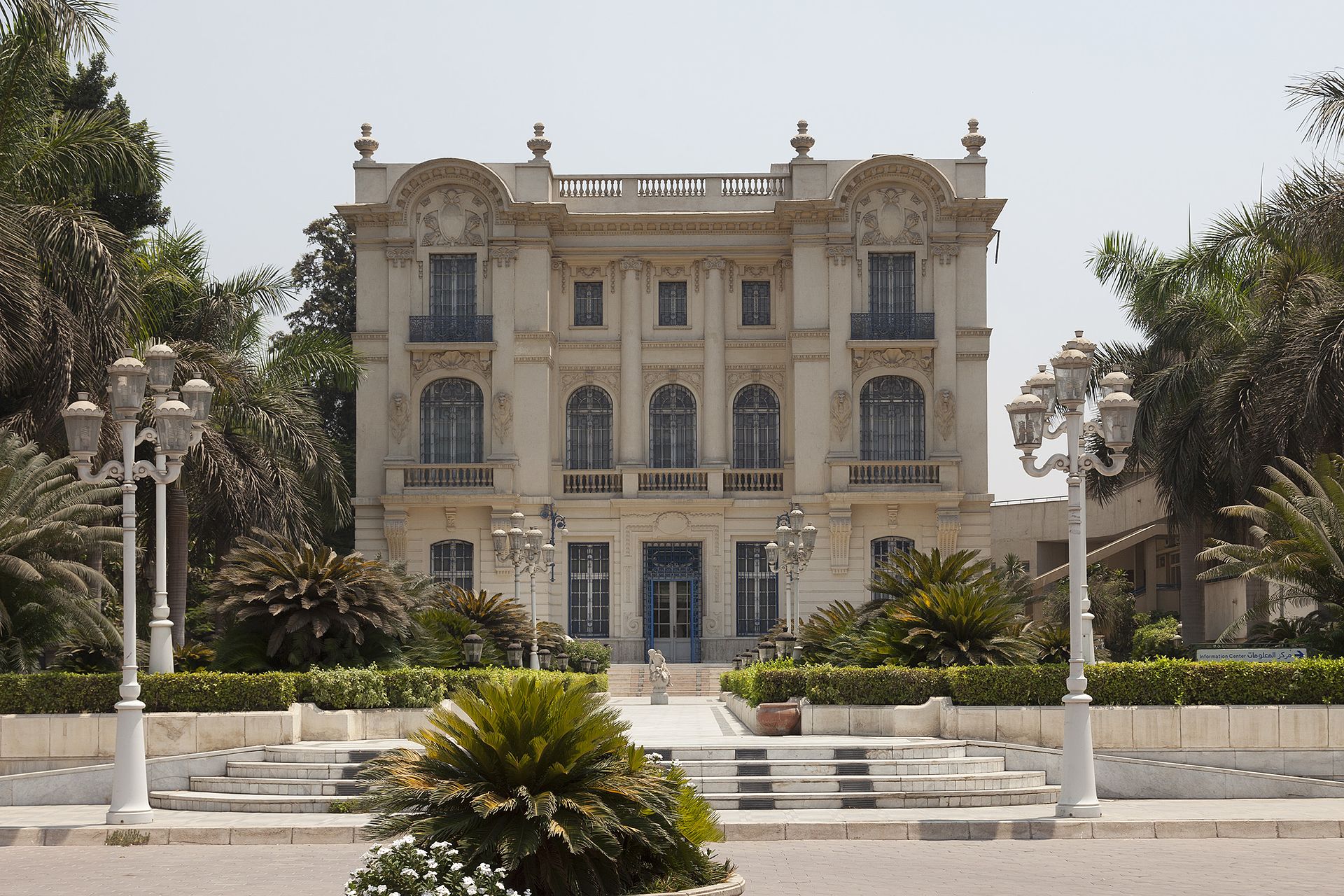
There is an odd geography to the Mahmoud Khalil Museum. You arrive at a handsome villa on the west bank of the Nile, in the Giza neighbourhood of Dokki, expecting — perhaps — a small biographical museum: a statesman's desk, some photographs, a library. What you find instead is Degas. And Renoir. And Gauguin. And Monet. And, in the next room, Ingres. The collection that Mohamed Mahmoud Khalil and his wife, Emilienne Luce, assembled in the first decades of the twentieth century is one of the finest private holdings of nineteenth-century French painting to have survived in a single place — and it is, by historical accident and testamentary decision, in Cairo.
Who was Mahmoud Khalil
Khalil was a Cairo-born lawyer who became, in succession, an elected member of the Egyptian parliament, president of the senate, and — briefly — a candidate for prime minister. He was also, by inclination and by purse, a serious collector. Between roughly 1915 and his death in 1953, he and his wife assembled more than two hundred paintings, sculptures, and decorative objects, bought chiefly at auction in Paris and London and shipped back to their villa on the Nile. The villa itself, built in the 1910s, is a confection of neoclassical pediment, Beaux-Arts flourish, and Mediterranean garden. Khalil bequeathed it, and the collection, to the state.
What followed, over the next seven decades, is a smaller story than the collection deserves. The museum has been closed and reopened several times; a significant theft in 2010 resulted in the loss of a Van Gogh (since recovered). A major restoration was completed in 2020, and the museum today presents the collection in conditions that, while still not perfect, are the best it has known.
The rooms, in order
The museum unfolds across two floors, with the ground floor devoted to the Impressionists and post-Impressionists and the upper floor holding earlier French academic painting, Orientalist canvases, and the decorative arts. My advice, for a first visit, is to go to the upper floor first and descend into the Impressionist rooms as a crescendo. The downstairs galleries will stay with you longer if you come to them second.
Upstairs: the academy
The upper floor contains the paintings Khalil bought earliest and cherished longest — Corot landscapes, a Delacroix small oil sketch, an Ingres drawing of exceptional delicacy. The Orientalist room, which can be awkward in a museum outside Europe, is handled here with a degree of curatorial self-awareness. The captions do not pretend that the paintings represent Egypt as it actually was; they describe, neutrally, what the French artist saw or imagined seeing, and leave the interpretation to the viewer. This is the right choice.
Downstairs: the Impressionists
The ground-floor rooms contain, among others, Degas pastels of dancers and bathers; a Monet water-lilies canvas from the second Giverny series; a small Pissarro — a street in Rouen, weather grey and specific; a Sisley river scene; a late Gauguin Tahitian; and a Van Gogh still life (the recovered painting, now hung behind enhanced glass). The stars of the collection are, I think, the Degas pastels. Khalil bought at least six, and the museum shows four. They are displayed at eye level, with lighting that respects the fragility of the medium, and they repay the kind of looking that museums rarely allow.
The Renoir — a nude, half-length, the paint thickly worked — is in a separate small room. So is the Gauguin. The curators have resisted the temptation to group every Impressionist on a single crowded wall, and the result is that each painting has room to breathe. I stood in front of the Gauguin for ten minutes on a Sunday and was the only person in the room.
The garden
The villa's garden is a reason in itself to visit. Ten minutes of careful planting along the Nile — a gravelled path, jasmine, a fig tree, two jacarandas that flower in April, a bench positioned so that you can look across the water at Zamalek. Khalil and Emilienne used to receive on this garden. There is a small café near the entrance, staffed by the museum, where a pot of tea and a plate of biscuits can be had for roughly the price of a metro ticket. On a spring afternoon, with the Degas pastels still working in your head, this is one of the more civilised half-hours central Cairo offers.
The ambient politics
A museum built from a private collection is always, to some extent, a museum of its collector. The Mahmoud Khalil is no exception. The paintings reflect the taste of an early-twentieth-century Egyptian statesman with cosmopolitan connections and Parisian auction catalogues. That is a specific moment in Egyptian cultural history — the moment when the Egyptian elite looked to Paris as the capital of modernity. To visit this museum is to encounter, materially, a particular version of Egyptian modernism.
One could wish, and some Egyptian critics do, that Khalil had collected more Egyptian contemporaries. The great Egyptian painters of his period — Mahmoud Mokhtar the sculptor, Mahmoud Said the painter, Ragheb Ayad — are absent. That is a real gap, and it is part of why the Museum of Modern Egyptian Art, a kilometre to the north on the Opera grounds, is its indispensable complement. But within the limits of what it is, the Mahmoud Khalil Museum is unanswerable. You will not see Degas pastels this good, this close, in conditions this quiet, at any public museum in Paris.
Practical
The museum is open six days a week, with a weekly closing day that varies — call before you go. Tickets are inexpensive. Photography is not permitted in the galleries (and this is correct, given the fragility of the pastels and the lighting that protects them). The museum is a short taxi ride from the Dokki metro station. Plan for ninety minutes in the galleries and another thirty in the garden. A full weekend afternoon is not wasted here.
What stayed with me
I left thinking about the logistics. The Degas pastels were bought in Paris, loaded onto a ship at Marseille, sailed across the Mediterranean, and unloaded at Alexandria; trucked — or train-loaded — up to Cairo; uncrated at a villa on the Nile. That journey, repeated many times in the 1920s and 1930s, is part of the history of these paintings. They are in Cairo not by accident but by the deliberate choice of an Egyptian collector. The museum that holds them is small, a little worn at the edges, and entirely worth the afternoon.