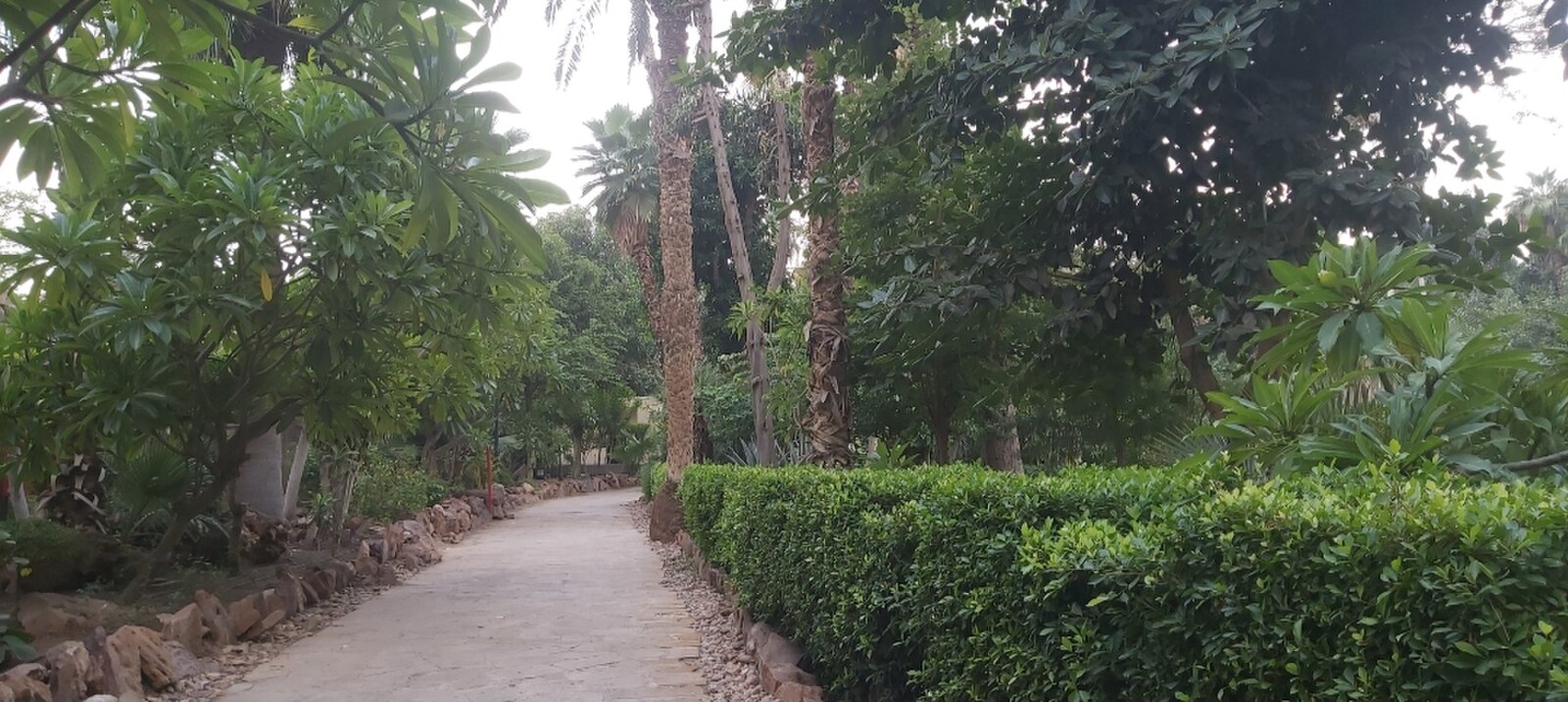
On Rhoda Island, in the middle of the Nile, there is a palace that does not quite fit any category. It was built between 1899 and 1929 by Prince Mohamed Ali Tewfik, a brother of the last Khedive of Egypt, and it is — depending on how you look at it — a residence, a museum, a botanical garden, a small Ottoman-style mosque, a hunting pavilion, a throne hall, and a reception house. The Manial Palace is all of these things on the same fourteen-acre site, arranged along gravel paths and shaded by trees the Prince planted himself.
This is the most eccentric royal museum in Cairo, and the loveliest.
Prince Mohamed Ali Tewfik was, by most accounts, a man more interested in aesthetics than in politics. He was, briefly, regent during the minority of King Farouk; he was, more durably, a collector, a gardener, and a patron of Cairene craftsmen. The palace he commissioned on Rhoda Island was designed as a series of separate buildings rather than a single grand house — a Reception Palace, a Residence Palace, a Hunting Museum, a small mosque, a clock tower, a throne hall. Each was executed in a different architectural register. The Residence borrows from Ottoman domestic architecture; the Mosque is modelled on the mosques of Andalusia; the Throne Hall is neo-Rococo; the Reception Palace draws on Mamluk, Persian, and Levantine decorative traditions.
The whole ensemble reads, at first pass, as an architectural anthology. Spend an hour walking between the buildings, and a more coherent vision emerges: an attempt to assemble, within one garden, the aesthetic vocabularies of the Islamic world, as one prince understood them. It is the building equivalent of a collector's cabinet.
The Reception Palace is where most visitors begin, and where the concentration of decorative richness is highest. A hall lined with Iznik tiles leads into a small salon with a painted wooden ceiling and a set of Persian miniatures in recessed alcoves. The prince's taste for blue-and-white runs through the building: Iznik tiles, Syrian tiles, Delft plaques, Chinese porcelain. He did not acquire them for reasons of national coherence; he acquired them because he liked blue-and-white ceramic, and the building is the richer for it.
Look up in each room. The ceilings are the best thing in the Reception Palace. Some are carved and painted wood in the Syrian tradition; others are stuccoed in intricate muqarnas; one is a painted scene of birds and flowers on a gold ground. None are reproductions — all are original work commissioned by the prince from Cairene or Damascene craftsmen.
The garden is the best reason to spend a morning at Manial. The prince was an amateur botanist of serious commitment and imported trees from across the Islamic world and beyond. A mature banyan, brought as a seedling from Calcutta, now shades half of the central lawn. A grove of royal palms lines the path to the mosque. A flowering jacaranda, visible from most of the grounds, carpets the gravel with violet in April. Bougainvillea — magenta, apricot, coral — climbs the trellises on the Residence Palace.
On a weekend morning the garden is barely populated. Families occasionally bring children. A bridal party might be photographed in front of the mosque. Otherwise, the place is yours. I recommend bringing a book and sitting for twenty minutes under the banyan. The acoustics of the garden — the filtered sound of traffic on the Corniche beyond the walls, the quieter sounds of the fountains — are among the best in central Cairo.
Attached to the grounds is one of the stranger small museums in the city. The Hunting Museum displays the prince's taxidermied trophies, arranged in dim glass cases: gazelles, a leopard, a herd of mounted heads from North African and sub-Saharan hunts, weapons, stuffed birds. This is a museum in the register of the 1920s, and it has the faint melancholy that all such museums acquire over time. Visit it — it is part of the site — but visit it briefly, and do not expect a contemporary curatorial apparatus. The Hunting Museum is a historical document in its own right.
The Residence, where the prince actually lived, contains his personal library, his bedroom, his study, and several formal salons. The library is the room I remember most clearly: a small, high room lined with bookshelves, the books in Arabic, French, Ottoman Turkish, and English. The prince's reading was catholic. A desk, a lamp, a single comfortable chair, a view of the garden through an Ottoman-style window: this was where the ensemble was designed.
The Manial Palace is reached by a short taxi ride from central Cairo. It is open six days a week, with the standard break in the middle of the day. Tickets are inexpensive; a separate small fee applies for cameras. Allow three hours for the full visit, including the garden. The on-site café at the entrance is serviceable but uninspired; I suggest walking, afterwards, the five minutes to the Nile-side restaurants of Manial's main street for a late lunch.
You will not find the Manial Palace on every list of things to do in Cairo, and this is, to some extent, its blessing. The site is large enough, and quiet enough, and strange enough, that a first visit is always a small adventure. It is also — and this is harder to convey in a short note — one of the most direct encounters with the Cairene early-twentieth century still available. The prince's taste, preferences, contradictions, and generous expenditure are legible everywhere. A weekend afternoon at Manial is an afternoon spent in the specific company of one man's mind. It leaves you thinking.

Farida writes about the cultural life of Cairo and the Delta. A former exhibitions producer for the Bibliotheca Alexandrina, she has been our editor since Cultury began.