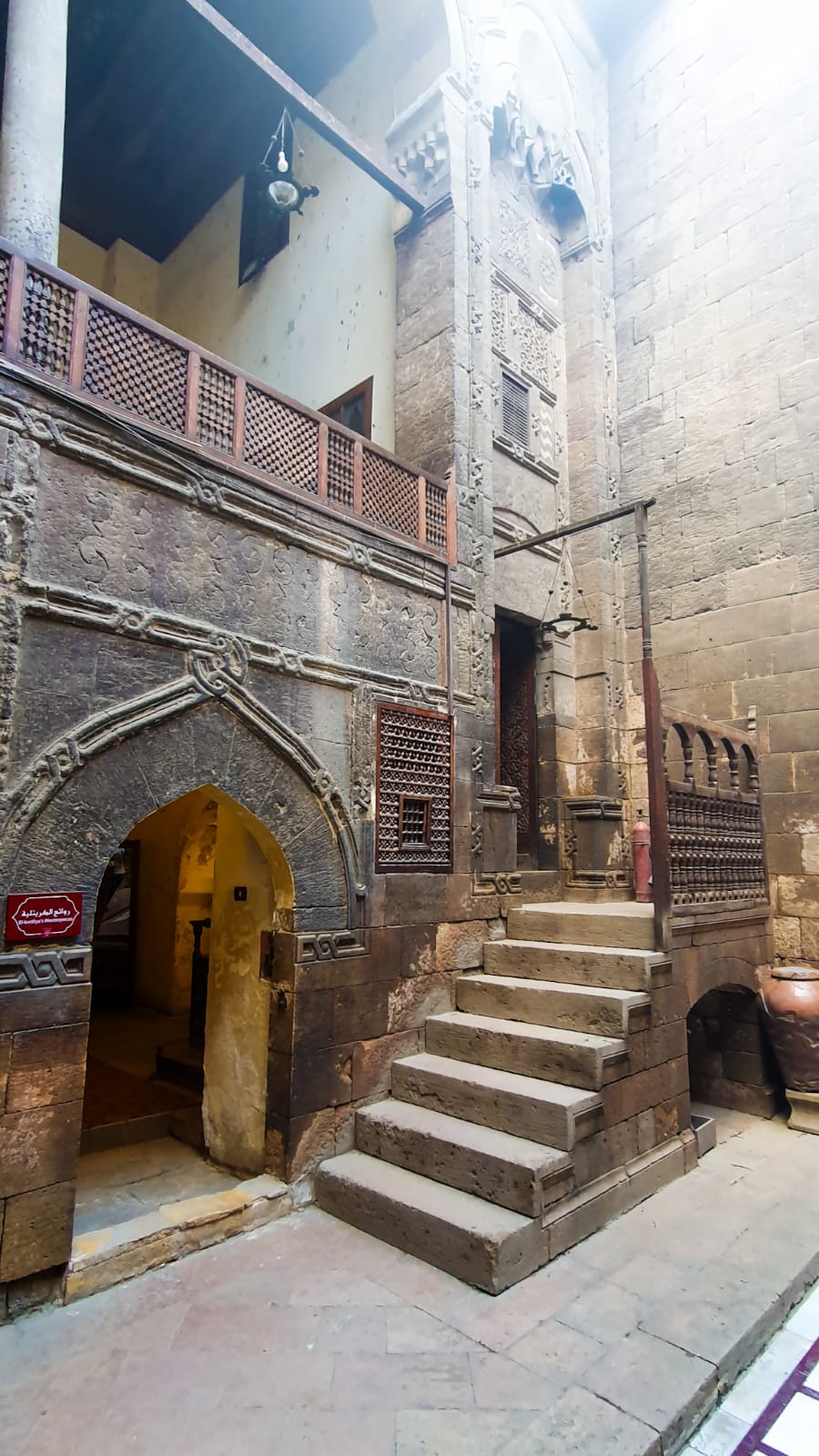
Behind the Mosque of Ibn Tulun in Sayyida Zeinab, two seventeenth-century Cairene houses have been joined by a bridge. The houses — Bayt al-Kritliyya, built in 1632 by a Cretan officer in the Ottoman army, and Bayt Amina, built in 1540 by Amina bint Salem — were adapted in the 1930s into the residence and collection of a British army major named Robert Grenville Gayer-Anderson. He filled the houses with Ottoman, Mamluk, Persian, Indian, and European antiques, furnished the rooms as if a family still lived in them, and bequeathed the entire complex to the Egyptian state in 1942. The houses opened to the public as a museum shortly afterwards. They have not really changed since.
This is, in consequence, a museum of a type that barely exists anywhere else. The interiors are neither a historical reconstruction nor a curated display: they are a collection as the collector actually lived with it.
The Major
Gayer-Anderson arrived in Cairo in 1907 as a medical officer in the Egyptian army. He served on and off in Egypt for the next thirty years, collecting steadily, learning Arabic and Turkish, and cultivating the particular kind of Orientalist domestic aesthetic that certain British officers of his generation cultivated. He was not a scholar. He was not a curator. He was, however, a collector of catholic taste and serious patience, and the two houses that bear his name are the record of what patience and taste can accomplish over thirty years in Cairo.
The houses themselves were the collection's starting point. By the time Gayer-Anderson acquired the lease on Bayt al-Kritliyya in 1935, the building was in poor condition — its wooden mashrabiya screens half-rotten, its courtyards full of rubble, its painted ceilings obscured under decades of repainting. Gayer-Anderson restored it room by room, commissioning Cairene craftsmen to repair rather than replace, and moved in. Shortly afterwards he acquired Bayt Amina, the adjacent house to the north, restored it similarly, and joined the two with a covered bridge at the first-floor level.
The route
Visitors enter through the ground-floor courtyard of Bayt al-Kritliyya. The courtyard is open to the sky, flagged in stone, with a small fountain at its centre. Rooms open off the courtyard on three sides: a reception room with a marble floor and painted wooden ceiling; a smaller sitting room with Ottoman divans and a shelf of bound Qurans; a pantry with copper cookware. You climb a staircase — low, deep steps, polished by use — to the first floor, where the rooms become more private and more densely furnished.
The first floor contains Gayer-Anderson's bedroom, his library, his dressing room, a women's salon with a ceiling inlaid in mother-of-pearl, and — the room most people remember — the Qa'a, a grand reception hall with a fountain in the centre and a richly painted muqarnas ceiling. The Qa'a is the centrepiece of the museum. Its scale is modest, but its decoration is extraordinary: the walls tiled in Iznik blue and white to shoulder height, the ceiling carved and gilded, the marble floor inlaid with coloured stone in a pattern of interlocking geometries.
The covered bridge to Bayt Amina crosses above the street and deposits you in the second house, which is both smaller and more domestic. Here you find the kitchens (stone-flagged, with a brick bread oven), additional salons, a small museum room with Gayer-Anderson's personal papers and photographs, and — at the top of the building — a terrace with a view over the roofs of medieval Cairo and across to the minaret of Ibn Tulun.
The James Bond footnote
In 1977, the film The Spy Who Loved Me used the Gayer-Anderson's Qa'a as a setting for a brief chase scene in which Roger Moore's James Bond encounters a villain's henchman. The scene is, frankly, brief and unmemorable, but it is one of the few things about the museum that first-time visitors tend to have heard. The attendants will, if asked, point out where the camera stood. They will also, with the faintest tone of weary amusement, clarify that no real James Bond ever visited.
What to look for
The collection is heterogeneous and intentionally so. Some highlights I would not miss: the Damascus ceiling panels in the Byzantine Room, carved in walnut and ebonised; the Persian miniatures in the upstairs study (small, exquisite, faded); the Chinese porcelain on display throughout the ground floor, which Gayer-Anderson accumulated from Cairo's long-established Chinese antique trade; and the Coptic textile fragments displayed in a single case in the women's salon. None of these objects is individually canonical. Collectively, they constitute a remarkably coherent portrait of one man's taste in Orientalia between 1907 and 1942.
Practical
The museum is open six days a week. The entrance is a small door in the north wall of Bayt al-Kritliyya, immediately west of the Mosque of Ibn Tulun. Tickets are inexpensive. Photography is permitted throughout. A visit takes ninety minutes to two hours if you are reading labels; an hour if you are walking through to absorb atmosphere. The Mosque of Ibn Tulun next door — one of the oldest mosques in Egypt still standing in its original form — is a natural companion visit, and together the two sites are the best morning in Sayyida Zeinab.
A closing note
The Gayer-Anderson Museum is a specific and slightly melancholy place. The British major is gone; the craftsmen who restored the ceilings are gone; the Egypt in which a British officer could lease a seventeenth-century house in a Cairo neighbourhood and settle down to collect is also gone. What remains is the object of the project — two interlinked houses, exquisitely restored, filled with things the collector loved, maintained by the Egyptian state, and open to anyone who wants to pay a small fee and step off the noise of medieval Cairo into a quiet interior. It is one of the great pleasures of the city. Go on a weekday morning if you can; the rooms are calmer.