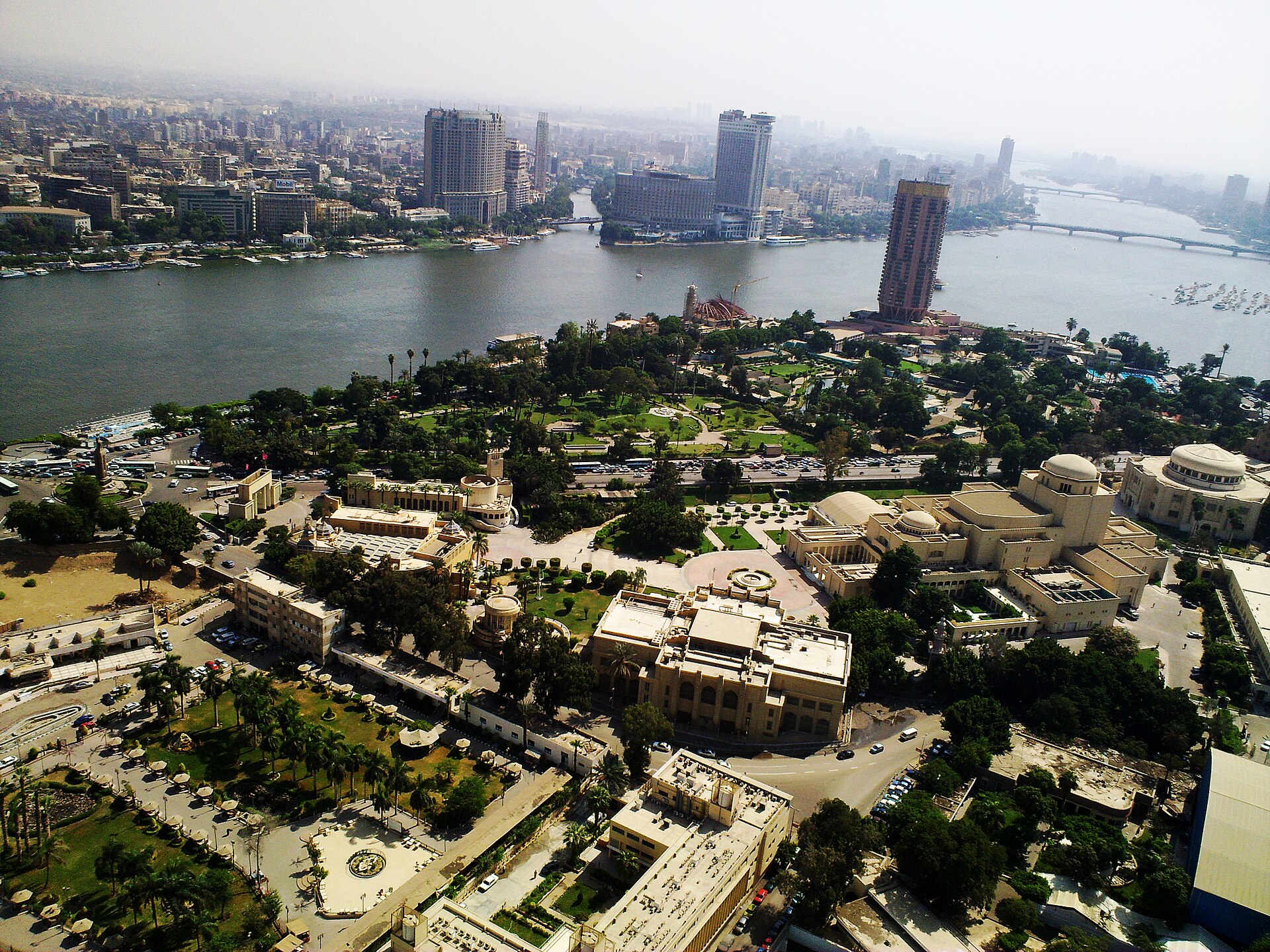
The Museum of Modern Egyptian Art sits on the northern edge of the Cairo Opera House grounds in Gezira, sharing a gated compound with the Opera itself, a concert hall, an arts education centre, and a pleasant open-air café under the trees. The setting is already a reason to come. The collection is the better one.
This is the museum where Egyptian painters of the twentieth century are held and shown — the pioneers of the 1910s and 1920s, the mid-century modernists, the abstractionists of the 1960s, the contemporary figures still working. If the pharaonic museums tell you what Egypt was three thousand years ago, this building tells you what Egyptian visual culture has been doing in the past hundred. It is, for the weekend visitor who has already worked through the antiquities, the necessary corrective.
The pioneers
The museum's earliest rooms are devoted to the generation of artists who founded modern Egyptian painting. Mahmoud Said, a lawyer turned painter from a wealthy Alexandria family, is the dominant figure; the museum holds several of his strongest canvases. Look for The Dervish and the series of portraits of working women. Said's style — a flattened figuration with a jewel-like palette and a debt to Italian Quattrocento — was unlike anything being produced in Cairo or Alexandria at the time. His reputation has grown steadily in the past two decades, and individual canvases now sell at international auction for figures that would have astonished his contemporaries.
Beside Said, the museum shows the sculptor Mahmoud Mokhtar, whose monumental granite figure Nahdat Misr (Egypt's Awakening) stands in front of Cairo University and whose smaller-scale bronzes and plaster maquettes are here in a dedicated gallery. Mokhtar's project — a sculptural language that drew on pharaonic precedent to argue for a modern Egyptian national identity — was one of the defining aesthetic enterprises of the 1920s.
The Surrealists
Cairo in the late 1930s and early 1940s had a Surrealist circle — the Art and Liberty group, founded in 1938 by Georges Henein, Ramses Younan, and Kamel el-Telmissany — which was in direct communication with André Breton's Paris circle and produced a body of work as politically urgent and aesthetically singular as any Surrealist movement of the period. The Museum of Modern Egyptian Art holds examples from all three founders, and the wall captions do the movement justice.
This is material that rewards slow looking. Egyptian Surrealism had its own vocabulary — more focused on the body, less on dream imagery, more politically explicit — and the canvases of Inji Efflatoun, Mahmoud Saad, and Abdel Hadi el-Gazzar on the adjacent wall belong to the same intellectual moment. The museum does not arrange them as a standalone movement, which is a small curatorial loss, but the works are here and they repay attention.
Mid-century abstraction
The galleries that follow trace Egyptian abstraction in the 1960s and 1970s — a period when many artists, Hamed Nada among them, moved toward a vocabulary that drew on Arabic calligraphy, folk motifs, and the flattened spatial logic of Coptic iconography. This room is the most aesthetically coherent part of the museum. The palette darkens, the scale grows, the figures dissolve into patterning. A Hamed Nada canvas — dense, reddish, with a calligraphic armature running diagonally across the surface — is the piece I returned to three times on my last visit.
Women painters
The museum does better than most Egyptian public collections in showing the work of women artists. Inji Efflatoun's prison paintings — made during her imprisonment between 1959 and 1963 for communist affiliation — are on permanent display in a small side room. Effat Naghi and Gazbia Sirry, both of whom worked productively into the 1990s and 2000s, are represented in the upper galleries. Tahia Halim, whose paintings of Nubian villages from the years around the High Dam have gained renewed attention, has a dedicated case.
The contemporary rooms
The museum's contemporary holdings — material from the 1990s and 2000s — are, inevitably, a work in progress. Some of the artists in these rooms are still active; their work is being collected, shown, rotated. This is the part of the museum that changes most between visits. On my last walk-through, a large canvas by Adel el-Siwi was hanging in the central gallery; three months later, it had been replaced with an installation by a younger painter. This is the right cadence for a contemporary collection.
The café and the grounds
The Opera grounds are one of central Cairo's most agreeable public spaces. After the museum, I recommend the café under the pergola — a pot of tea, a plate of fresh-baked biscuits, a view of Zamalek across the grass. If the weather is mild, sit outside. If it is hot, the air-conditioned interior is one of the more comfortable reading rooms in the city.
In the evenings the Opera grounds come alive: concerts at the main hall, smaller performances at the Hanager Arts Centre, families strolling in the gardens. A museum visit in the late afternoon, followed by a concert in the evening, is an unusually civilised Cairo Saturday.
Practical
The museum is open six days a week. Admission is inexpensive. Photography is permitted in some galleries and not in others; the rules are labelled at each entrance. The grounds are accessed through the main gate on the Gezira side of the Opera compound; bring identification, as there is a routine security check. Plan for two hours in the museum and an hour afterwards in the café and gardens. The closest metro station is Opera, on the north side of Zamalek.
Why this museum matters
Egypt has a well-known problem with how it presents its modern art abroad. The Tutankhamun touring exhibitions crowd out the Mahmoud Saids; the Giza pyramids crowd out the Hamed Nadas. The consequence is that the international image of Egyptian visual culture ends, for most foreigners, at around 30 BCE. The Museum of Modern Egyptian Art is the specific institution that holds and shows the hundred years since — and it does so in one of the pleasanter buildings in Cairo, with some of the most interesting painting the country has produced. It deserves an afternoon. It usually gets, from the average visitor, none.